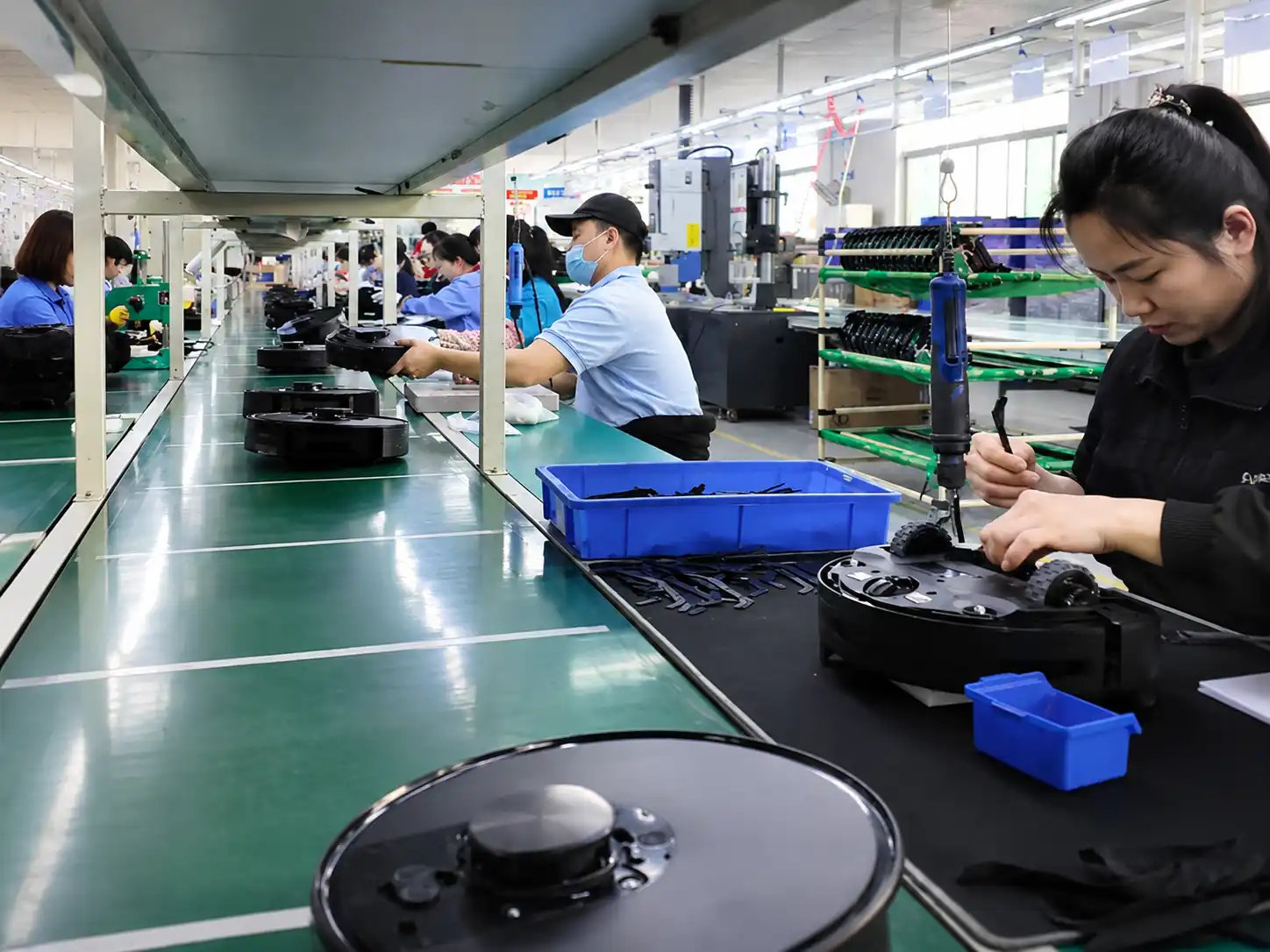
Finding the right robot vacuum manufacturer in China is a different task from buying a robot vacuum. Importers, distributors, and private-label brands need to know who actually builds the machines, who will put your logo on them, and who is simply selling their own brand. This guide covers the top 10 robot vacuum manufacturers in China — from listed giants to Shenzhen OEM specialists — with the facts that matter for a sourcing decision.
How this list was built. We selected manufacturers with verifiable production operations in China and robot vacuums as a core product line, using public sources (company filings, Wikipedia, trade press). This is a curated comparison, not a definitive ranking — order reflects a blend of scale, OEM openness, and relevance to B2B buyers. Disclosure: this guide is published by Kingbot, who appears below as one of the ten. Facts were checked against public sources in October 2026.
The 10 Manufacturers at a Glance
Before the detailed profiles, here is the short version. If you already know whether you need an OEM partner or a brand to distribute, this table will point you to the right section.
| # | Manufacturer | HQ | Founded | Core strength | OEM for others | Best for |
|---|---|---|---|---|---|---|
| 1 | Ecovacs | Suzhou | 1998 | DEEBOT vacuums, WINBOT | No public program | Quality benchmark |
| 2 | Roborock | Beijing | 2014 | LiDAR navigation | Historically (Xiaomi) | Tech benchmark |
| 3 | Dreame | Suzhou | 2017 | High-speed motors | Yes (Xiaomi, motors) | Component supply chain |
| 4 | Narwal | Shenzhen | 2016 | Mop-washing docks | No public program | Design benchmark |
| 5 | Midea | Foshan | 1968 | Appliance scale, KUKA | Yes (group-wide) | Very large volumes |
| 6 | Haier | Qingdao | 1984 | Global compliance | Yes (group-wide) | Certification readiness |
| 7 | Minfutech | Shenzhen | 2021 | Pure-B2B cleaning appliances | Yes (core business) | Private-label brands |
| 8 | Mamibot | Shanghai | 2013 | Window robots, EXVAC | No verified program | Brand distribution |
| 9 | ILIFE | Shenzhen | 2007 | Value vacuums, ex-OEM | Historically | Market education |
| 10 | Kingbot | Shenzhen | — | 4-category OEM/wholesale | Yes (core business) | Responsive OEM partner |
1. Ecovacs Robotics(科沃斯)
- Headquarters: Suzhou, Jiangsu
- Founded: 1998
- Known for: DEEBOT robot vacuums, WINBOT window robots
- OEM for other brands: No public program (own-brand focus)
Ecovacs is China’s original robot-vacuum pioneer and the only pure-play cleaning-robot company listed on the Shanghai Stock Exchange (603486). Its DEEBOT line defined the domestic market, and its WINBOT series made it one of the few companies with serious window-cleaning robots alongside floor robots. With more than 25 years of manufacturing history, Ecovacs operates at a scale few competitors can match.
For B2B buyers, the honest caveat is that Ecovacs is an own-brand company first. It does not run a public OEM program for third-party labels, so it belongs on this list as a manufacturing benchmark rather than a sourcing option for private-label projects.
Best for: buyers who want to understand the quality ceiling of Chinese manufacturing — and retailers seeking an established brand to distribute rather than a factory to build with.
2. Roborock(石头科技)
- Headquarters: Beijing
- Founded: 2014
- Known for: LiDAR-navigation robot vacuums
- OEM for other brands: Yes — historically (Xiaomi Mi Home vacuum, 2016)
Born inside the Xiaomi ecosystem, Roborock listed on Shanghai’s STAR Market in 2020 and became the global reference for LiDAR-based navigation. Its early history is directly relevant to OEM buyers: the company’s first breakout product was manufactured for Xiaomi, proving its contract-manufacturing discipline before it pivoted to its own brand.
Today Roborock is firmly own-brand, and its OEM window has effectively closed. It remains on this list because its engineering standards — navigation algorithms, mop-lift mechanisms, dock design — set the bar every OEM factory is measured against.
Best for: technology benchmarking; distributors looking for a premium brand line rather than OEM capacity.
3. Dreame Technology(追觅科技)
- Headquarters: Suzhou, Jiangsu
- Founded: 2017
- Known for: High-speed digital motors, premium vacuum-mops
- OEM for other brands: Yes — Xiaomi OEM plus motor supply to third parties
Dreame grew out of Xiaomi’s ecosystem with a genuine core technology: high-speed digital motors running at 150,000–200,000 rpm, which it also supplies to other manufacturers. At one point roughly a third of its revenue came from Xiaomi OEM work, and it continues to sell motors and components B2B even as its own brand expands.
For sourcing professionals, Dreame is interesting less as an OEM partner (its own brand now dominates its capacity) and more as evidence of how deep Suzhou’s component supply chain runs — the same motor technology is available to qualified OEM factories.
Best for: understanding component-level supply chains; buyers who may source motors or modules separately from finished units.
4. Narwal(云鲸)
- Headquarters: Shenzhen, Guangdong
- Founded: 2016
- Known for: Self-cleaning mop docks
- OEM for other brands: No public program (own-brand focus)
Narwal pioneered the auto mop-washing dock — the feature that turned robot vacuums from “vacuums with a wet cloth” into genuine mopping machines. Its Shenzhen R&D base and rapid iteration speed made it the design reference for the entire industry’s docking stations within three years of launch.
Like the other consumer brands on this list, Narwal does not offer third-party OEM. Its value to B2B readers is as a design benchmark: any OEM factory you evaluate should be able to explain how its dock design compares to what Narwal standardized.
Best for: dock-design benchmarking; retailers seeking an innovative brand to carry.
5. Midea Group(美的集团)
- Headquarters: Foshan, Guangdong
- Founded: 1968
- Known for: Fortune 500 appliances; owns KUKA robotics
- OEM for other brands: Yes — one of the world’s largest appliance OEMs group-wide
Midea is a Fortune 500 giant whose OEM business spans nearly every home-appliance category. Its robotics arm (anchored by the KUKA acquisition) gives it automation depth that pure-play vacuum brands cannot match. Robot vacuums are a small line within a vast portfolio, but the manufacturing system behind them is industrial-grade.
The trade-off for B2B buyers is access: Midea’s OEM programs favor large-volume, long-term partners. Mid-size importers often find more responsive partners among Shenzhen specialists — but for container-scale programs, Midea’s capacity is unmatched.
Best for: very large volume programs where capacity and financial stability outweigh customization flexibility.
6. Haier Group(海尔集团)
- Headquarters: Qingdao, Shandong
- Founded: 1984
- Known for: Global appliances; owns GE Appliances, Candy
- OEM for other brands: Yes — group-wide OEM/ODM across appliances
Haier’s global footprint — GE Appliances in the US, Candy in Europe, Fisher & Paykel in Oceania — makes it the Chinese manufacturer with the deepest understanding of Western certification and retail requirements. Its robot vacuums (CIVIC series and others) benefit from the same compliance infrastructure.
For OEM buyers, Haier’s strength is regulatory readiness: CE, FCC, and UL pathways are well-trodden. The consideration is the same as with Midea — scale favors larger partners, and product decisions move through a large organization.
Best for: buyers who prioritize certification readiness and global after-sales networks.
7. Minfutech
- Headquarters: Shenzhen, Guangdong
- Founded: 2021
- Known for: Pure-B2B smart cleaning appliances
- OEM for other brands: Yes — explicitly “OEM Robot Vacuum & Cleaning Robot Manufacturer”
Minfutech represents the newer Shenzhen model: a factory built from day one for B2B, with robot vacuums, wet-dry washers, and pool robots developed for other brands rather than a consumer label. Its public capacity claims exceed 100,000 units per month, and its marketing speaks directly to importers and private-label buyers.
For sourcing teams, pure-B2B factories like Minfutech deserve attention because their incentives align with yours — their business depends on your reorder, not on competing with you at retail. Verify capacity claims with a factory audit before committing, as with any young manufacturer.
Best for: private-label brands that want a factory whose entire business model is B2B.
8. Mamibot
- Headquarters: Shanghai, China
- Founded: 2013
- Known for: Window cleaning robots, EXVAC vacuums
- OEM for other brands: No verified program (own-brand + wholesale)
Mamibot has been in cleaning robotics for over a decade, with particular strength in window-cleaning robots — a niche where it ranks well internationally — alongside its EXVAC robot vacuum series. Its US-incorporated sales entity and long Alibaba/Global Sources presence make it one of the more accessible Chinese suppliers for Western buyers.
Its model leans toward branded wholesale rather than true OEM: you can buy Mamibot products, but building your own label on their platform is not their core business. Useful as a benchmark for window-robot capability when evaluating multi-category factories.
Best for: distributors seeking an established brand to resell, especially in window-cleaning robots.
9. ILIFE
- Headquarters: Shenzhen, Guangdong
- Founded: 2007
- Known for: Value robot vacuums; ex-OEM turned global brand
- OEM for other brands: Yes — historically (produced for 10+ brands including Ecovacs)
ILIFE’s story is the most instructive on this list for OEM buyers. It began as a pure OEM factory in Shenzhen, producing robot vacuums for more than a dozen domestic and overseas brands — including Ecovacs — with annual shipments exceeding two million units at peak. It then exited OEM entirely to build its own brand, which now sells in 40+ countries.
That history cuts two ways: ILIFE proves Shenzhen’s OEM manufacturing depth is real, but the company itself no longer offers third-party manufacturing. Include it in your market education, not your RFQ list.
Best for: understanding the OEM-to-brand trajectory; a case study in Shenzhen manufacturing capability.
10. Kingbot
- Headquarters: Shenzhen, Guangdong
- Known for: Home-use cleaning robots: vacuums, window, pool & floor washers
- OEM for other brands: Yes — OEM/ODM + wholesale programs (core business)
- Trial orders: From 500 units
Kingbot is the publisher of this guide — an integrated factory-and-trade operation in Shenzhen’s Longgang district covering robot vacuums, window-cleaning robots, robotic pool cleaners, and wet-dry floor washers. Unlike the consumer brands above, Kingbot exists to build other companies’ brands: OEM/ODM customization and wholesale programs are the core business, not a sideline.
What that means in practice: a dedicated OEM/ODM program, auditable factory operations with 100% pre-shipment inspection, and trial orders from 500 units. If your shortlist needs at least one factory whose incentives point the same direction as yours, start a conversation.
Best for: importers, distributors, and Amazon sellers who want a responsive OEM partner across four cleaning-robot categories — not just vacuums.
How to Use This List: A 3-Step Shortlist Method

Step 1 — Decide what you’re actually buying
A brand to distribute and a factory to build with are different purchases. If you want your logo on the box, cross off the own-brand giants (Ecovacs, Roborock, Narwal) and focus on the OEM-open names: Minfutech, Midea, Haier, and Kingbot. Our OEM/ODM program page explains what customization depth to expect.
Step 2 — Match factory scale to your order size
Giants optimize for container-scale, multi-year programs. If your first order is a 500-unit trial — the standard entry point for serious private-label testing — you will get faster answers from Shenzhen specialists. See our wholesale programs and request a detailed MOQ quotation for your target configuration.
Step 3 — Audit before you commit
Every factory on this list looks good on paper. Ask for the production line video, the QC checklist, and two export references before wiring a deposit. Our factory page shows what a transparent audit trail looks like — hold every candidate to the same standard, including us.
Frequently Asked Questions
Which Chinese robot vacuum manufacturer is best for OEM?
It depends on your order size and customization needs. Midea and Haier suit very large programs; Shenzhen specialists like Minfutech and Kingbot are more responsive for 500-unit trial orders and deeper OEM customization. Always verify with a factory audit — see our OEM robot vacuum guide.
Do Ecovacs, Roborock, or Dreame offer OEM for other brands?
Not as public programs. Roborock and Dreame both did Xiaomi OEM work early in their histories, but today they are own-brand companies. For third-party labels, look to factories whose core business is B2B.
What MOQ should I expect from a Chinese robot vacuum factory?
For established models with light customization, 500 units is the common trial-order threshold. Deep ODM with new tooling typically starts higher. Our wholesale program page outlines the standard trial structure.
How do I verify a robot vacuum manufacturer before ordering?
Request a live production-line video, the QC inspection checklist, export references, and certification documents (CE, RoHS, FCC). A legitimate factory will provide these without hesitation — this is standard practice, not an imposition.
Why does this list include Kingbot itself?
Transparency: this guide is published by Kingbot, and we believe a comparison that hides its author is less trustworthy than one that discloses it. Evaluate us with the same skepticism you apply to everyone else on this list — then talk to us.
If you have shortlisted two or three factories from this guide, send us your target specs and quantities — we’ll respond with a manufacturability assessment and a 500-unit trial quotation path within one business day. You can also browse our full product range or start from the robot vacuum manufacturer hub.