
Home / Wet Dry Vacuum Cleaners / M2.0
MID-RANGE · COLD-AIR DRYING
M2.0 Wet Dry Vacuum Cleaner
The mid-range air-dry workhorse. Everything the entry model does, plus a cold-air drying cycle that keeps the roller fresh between cleans — without paying for heated drying you may not need.
230W
18KPA suction
55–60min
smart-mode runtime
Air-dry
self-cleaning roller
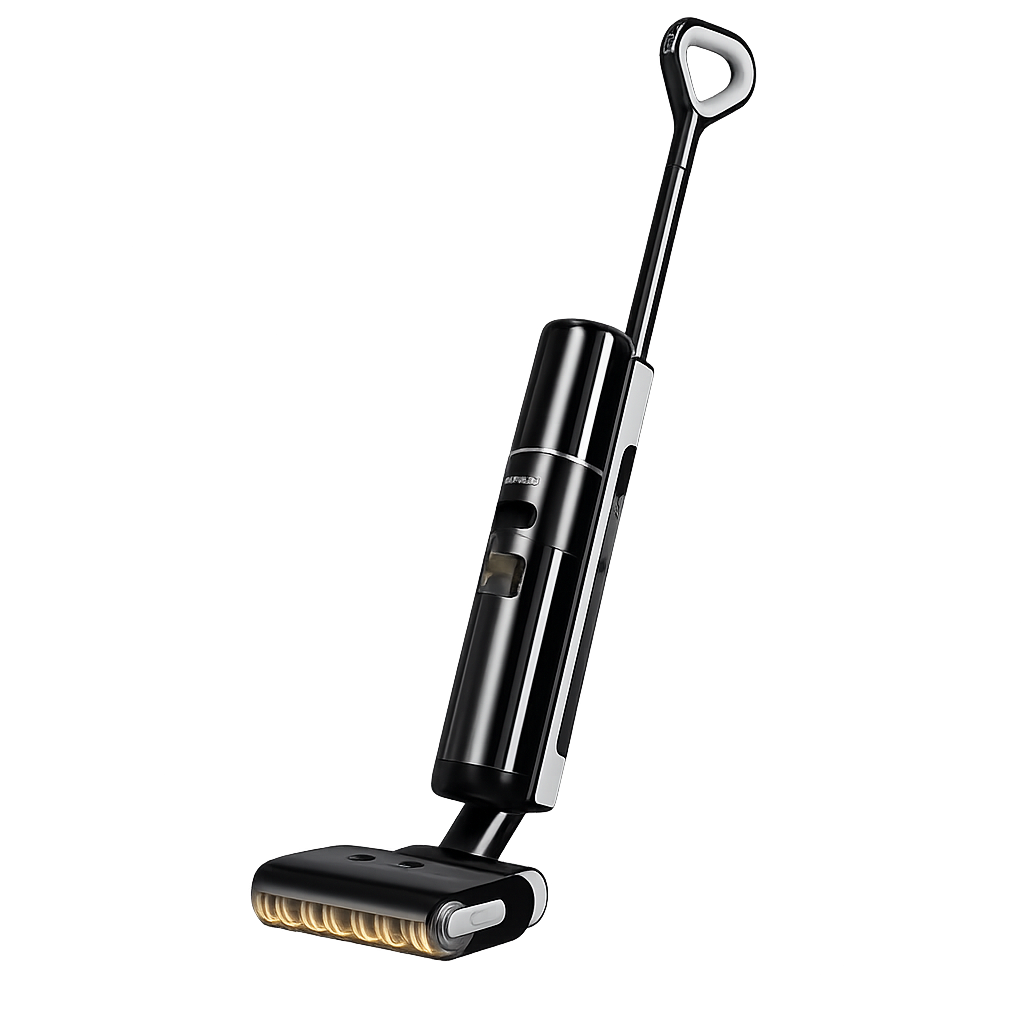
A Mid-Range Wet Dry Vacuum Built Around One Upgrade
Buyers comparing mid-range wet dry vacuum models usually circle the same question: is the step up from entry-level worth it, or should you jump straight to the flagship? The M2.0 exists for the buyer who answers “neither.” It takes the proven entry platform — 230W brushless motor, 18KPA suction, dual-tank water system — and adds exactly one meaningful upgrade: a cold-air drying cycle for the roller brush after every self-clean.
That single addition solves the most common complaint about basic floor washers: a roller that smells musty by day three. After the M2.0 finishes its self-cleaning rinse, the base station moves room-temperature air across the brush until it is dry to the touch. No heating element, no extra power draw, no heat-aged plastic parts — just a dry roller, ready for the next clean. For households and retail buyers in normal humidity, that is the whole job done.
What the extra spend over the M1.0 entry model buys you, concretely: the air-dry cycle, a larger 21700 4000mAh battery pack (55–60 minutes in smart mode versus the entry model’s shorter runtime), and a retail story your listing can actually use — “self-drying roller” photographs well and reads as a genuine step up. What it does not buy: heated drying. If your market demands hot-air drying for humid climates or premium positioning, that is the M3.0 flagship’s territory.
In short: the M2.0 is the air-dry floor washer for distributors and brands who want a credible mid-tier SKU — differentiated enough to sit above entry models on the shelf, priced well below heated-drying flagships. The comparison table below lays out exactly where each of the three platforms lands.
Why Cold-Air Drying Is the Sensible Middle
Heated drying is excellent — and expensive. Spin-only drying is cheap — and leaves the roller damp. The M2.0’s cold-air cycle is engineered for the large middle of the market.

A Dry Roller Without the Heating Bill
Here is the physics that matters: a roller left damp after self-cleaning grows odor-causing bacteria within 48 hours in a warm home. Entry models rely on centrifugal spin to fling water off — effective at removing bulk water, poor at removing the last film of moisture where odor starts. The M2.0’s base station follows the rinse with a sustained stream of room-temperature air directed across the full brush width.
Because there is no heating element, three things stay in your favor. First, cost: the bill of materials stays close to entry-level, which is why the M2.0 can sit in the mid-range price band instead of the premium one. Second, energy: the drying cycle draws a fraction of what a heater would, so the feature doesn’t meaningfully change the product’s power profile or your energy-label paperwork. Third, longevity: no repeated heat cycling on the brush housing and base plastics, which is one less aging mechanism in your warranty math.
The honest boundary: in persistently humid climates — think tropical markets or bathrooms that never fully ventilate — heated drying still wins on speed. That is a real segment, and it is exactly what the M3.0’s hot-air system is for. For everyone else, cold air does the job at a price the mass market accepts.
Clean Water In, Dirty Water Out — Never Mixed
The M2.0 carries 750ml of clean water and 720ml of dirty water in fully separated tanks. A 16-hole spray bar lays an even film ahead of the roller, the 18KPA suction recovers it on the same pass, and the dirty tank seals shut so nothing sloshes back onto a just-cleaned floor. It sounds basic; it is the difference between mopping and actually cleaning.
Each tank is pressure-tested for leakage before the unit leaves the line — water and electronics share a chassis in every wet dry vacuum, so tank sealing is a safety item, not a convenience one. The dirty tank lifts out one-handed for sink emptying, and the wide mouth means no brush is needed to scrub residue out of corners.
For your retail copy, this is the “always mops with clean water” claim — simple, visual, and immediately understood by any buyer who has ever wrung out a gray mop.


Edge-to-Edge: the Detail Retail Photos Miss
Most floor washers leave a 2–3cm uncleaned strip along baseboards — the exact zone where dust lines are most visible. The M2.0’s brush head runs edge-to-edge on both sides, so the roller reaches the wall line in a single pass. No second pass, no hand-mop follow-up along the skirting.
This matters more than it sounds for your return rate: “doesn’t clean edges” is one of the top three complaints in floor-washer reviews across marketplaces. Designing it out at the brush-head level is cheaper than answering it in customer service later.
55–60 Minutes From a Real Battery Pack
The M2.0 runs a 21700-cell 4000mAh 6S1P pack — the same cell format the flagship uses — delivering 55–60 minutes in smart mode and 35–40 minutes at full power. That covers roughly 200–280m² of hard floor per charge in real homes, which means most buyers finish the whole flat without a mid-clean recharge.
Runtime claims are where cheap floor washers lie most often, so here is the testable version: smart mode at default suction on sealed hard floor, clean tank full, dirty tank empty. Your QC team can replicate it on the sample in an afternoon — we encourage it. The 120,000 RPM brushless motor holds 18KPA across the discharge curve rather than fading as voltage drops, so the last ten minutes clean like the first ten.
At 4.2kg net, the M2.0 stays light enough for one-handed stair carries — a spec nobody brags about until they’ve lifted a 6kg competitor.
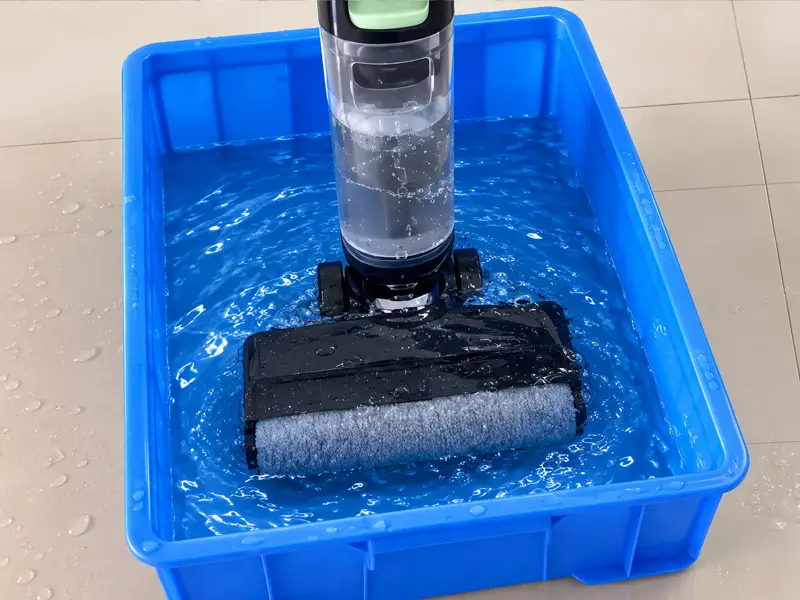
M2.0 Full Specifications
Measured values from the production specification — the same sheet your sample will be checked against.
| Motor | 230W brushless (BLDC), 120,000 RPM |
| Suction | 18KPA, adjustable |
| Battery | 21700 4000mAh 6S1P, built-in |
| Runtime | 55–60 min (smart mode) / 35–40 min (max mode) |
| Charging time | 4–5 hours |
| Drying system | Self-cleaning + cold-air drying (no heating element) |
| Clean water tank | 750ml |
| Dirty water tank | 720ml |
| Water spray | 16-hole spray bar |
| Edge cleaning | Dual edge-to-edge brush head |
| Noise | 65dB (whole-machine noise reduction) |
| Voice prompts | Chinese / English |
| Display | Smart LED with fault alerts |
| Unit dimensions | 371 × 244 × 1114mm |
| Net / gross weight | 4.2kg / 6.0kg |
| Carton | 775 × 309 × 231mm, 5-ply kraft |
| Certifications | CE, RoHS, FCC, MSDS |
| In the box | Main unit, self-cleaning base, soft roller brush, adapter, HEPA filter, cleaning brush, outer carton, manual, battery pack |
Need the full engineering sheet with tolerances? Ask our team — we send it before you commit to samples.
M2.0 vs M1.0 vs M3.0: Where Each Platform Lands
One series, three price bands. Pick by the story your channel needs to tell — not just the spec sheet.
| M1.0 Entry | M2.0 Mid-Range (this page) | M3.0 Flagship | |
|---|---|---|---|
| Drying method | Self-cleaning spin-dry | Self-cleaning + cold-air drying | Self-cleaning + hot-air drying |
| Runtime (smart / max) | 35–40 / 20–25 min | 55–60 / 35–40 min | 55–60 / 35–40 min |
| Battery | 18650 2500mAh 6S1P | 21700 4000mAh 6S1P | 21700 4000mAh 6S1P |
| Motor / suction | 200W / 18KPA | 230W / 18KPA | 230W / 18KPA |
| Net weight | 3.9kg | 4.2kg | 4.2kg |
| Best for | Price-led volume retail | Mid-tier listings that need a real differentiator | Premium channels, humid markets |
Read the table as a buying decision, not a spec contest. If your channel competes on price alone, the M1.0’s lower bill of materials wins. If you need a mid-shelf story — “self-drying roller” on the listing, a demonstrable step above entry models in store — the M2.0 is the cheapest credible way to tell it. And if your buyers live in humid climates or you’re positioning at the top of the category, heated drying is worth the M3.0 premium. Our OEM team can walk through which platform fits your target retail price before you order samples.
Who Should Pick the M2.0
Amazon & marketplace sellers
You need a listing with a visible, photographable advantage over the entry-level crowd. “Cold-air self-drying roller” gives you a bullet point competitors at your price can’t match — and it’s a real feature, not marketing foam, so it survives the review section.
Regional distributors
You need a mid-tier SKU that sits cleanly between your entry and premium lines without cannibalizing either. The M2.0’s air-dry story creates that separation on the shelf, and the 500-unit MOQ keeps the inventory commitment manageable. See wholesale terms.
Private-label brands
You want a product that feels like yours. The M2.0 supports the full OEM treatment — housing colors, logo, packaging, manual language — detailed on our OEM page. Mid-range is where private label margins live. See how our OEM/ODM program works.
When to look elsewhere
If your entire strategy is lowest landed cost, the M1.0 will serve you better. If you sell into persistently humid markets or at premium price points, step up to the M3.0’s heated drying. Honest fit beats a forced sale.
Related Models
ENTRY
M1.0 Wet Dry Vacuum Cleaner
The volume model: 200W, spin-dry self-cleaning, 35–40 min runtime. Lowest landed cost in the series.
FLAGSHIP
M3.0 Wet Dry Vacuum Cleaner
The premium pick: hot-air drying, 21700 battery, 55–60 min runtime. For humid markets and top-shelf positioning.
SERIES
All Wet Dry Vacuum Cleaners
Compare the full floor-washer range, OEM programs and wholesale terms in one place.
See the Line Run
Production, testing and packing — the same floor your M2.0 order would run on.
M2.0 Questions, Answered
Is cold-air drying actually enough, or do I need heated drying?
For most homes and climates, yes. Cold-air drying removes the residual moisture that causes roller odor within 48 hours — which is the actual problem buyers complain about. Heated drying wins on speed in persistently humid environments (tropical markets, unventilated bathrooms). If that describes your market, the M3.0’s hot-air system is the honest recommendation; otherwise the M2.0’s cold-air cycle does the job at a meaningfully lower cost.
What exactly does the M2.0 add over the M1.0?
Three things: the cold-air drying cycle, a larger 21700 4000mAh battery (55–60 min smart-mode runtime vs the M1.0’s 35–40), and a stronger 230W motor. In retail terms, you get a demonstrable mid-tier story — “self-drying roller” — that the entry model can’t claim. If your channel competes purely on price, the M1.0 remains the better pick.
M2.0 vs M3.0 — when is the flagship worth the premium?
Choose the M3.0 when your positioning demands it: premium shelf placement, humid-climate markets where heated drying is a selling point, or a flagship halo SKU above a volume range. Choose the M2.0 when you need the strongest mid-range value story — most distributors find the M2.0 covers 70–80% of their mid-tier demand.
How long does the M2.0 really run on one charge?
55–60 minutes in smart mode, 35–40 minutes at maximum suction — measured on sealed hard floor with a full clean tank. That covers roughly 200–280m² per charge. We encourage buyers to replicate the test on their sample; the 120,000 RPM brushless motor holds suction across the discharge curve rather than fading as voltage drops.
Can I private-label the M2.0 with my brand?
Yes — the M2.0 supports the full OEM program: housing colors, logo printing, custom retail packaging, manual translation, carton marks and accessory bundles. Details are on our OEM wet dry vacuum cleaner page. The mid-range is typically where private-label margins are healthiest.
What is the MOQ and how do samples work?
The standard MOQ is 500 units. We recommend starting with a functional sample so your team can verify suction, runtime, drying performance and build quality before committing — see our MOQ and pricing guide for the full process. Samples typically ship within days when stock is available.
Which certifications does the M2.0 carry?
CE, RoHS, FCC and MSDS come standard with every unit, with documentation to support your import filing. If your market needs additional testing (UL/ETL for North America, for example), talk to us early — component-level preparation is far cheaper than retrofitting. Our manufacturer page covers how we handle compliance paperwork.
What maintenance does the roller need between cleans?
Almost none day-to-day: the self-cleaning rinse plus cold-air drying cycle handles it after each use. We recommend a monthly check — rinse the dirty tank, inspect the roller for wrapped hair, wipe the charging contacts. The roller is a replaceable wear part; spare-part supply is part of every distributor agreement so your after-sales stays simple.
Ask About the M2.0
Samples, OEM options, or a distributor quote — tell us your target market and quantity.