
SG30 Gyroscope Robot Vacuum
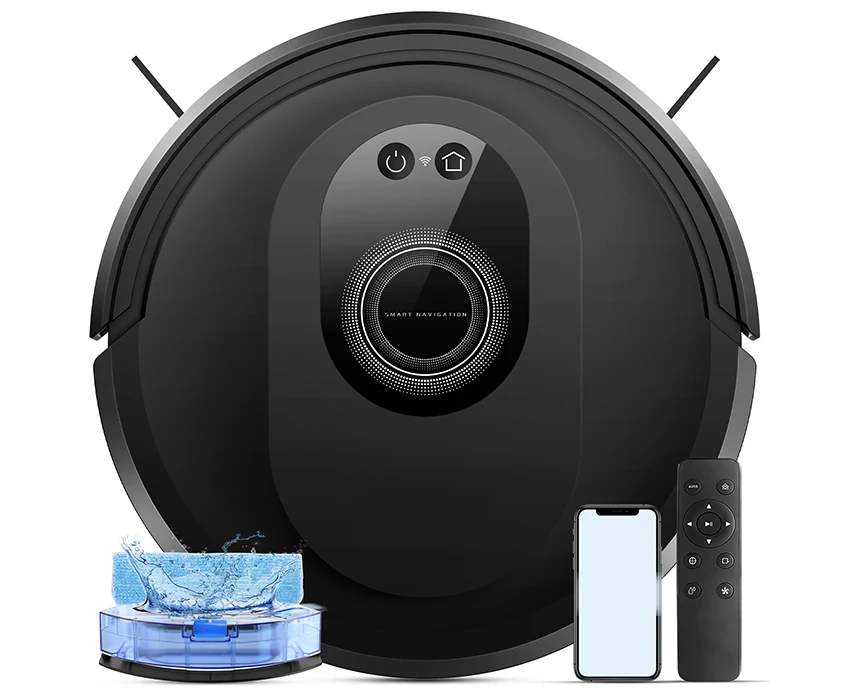
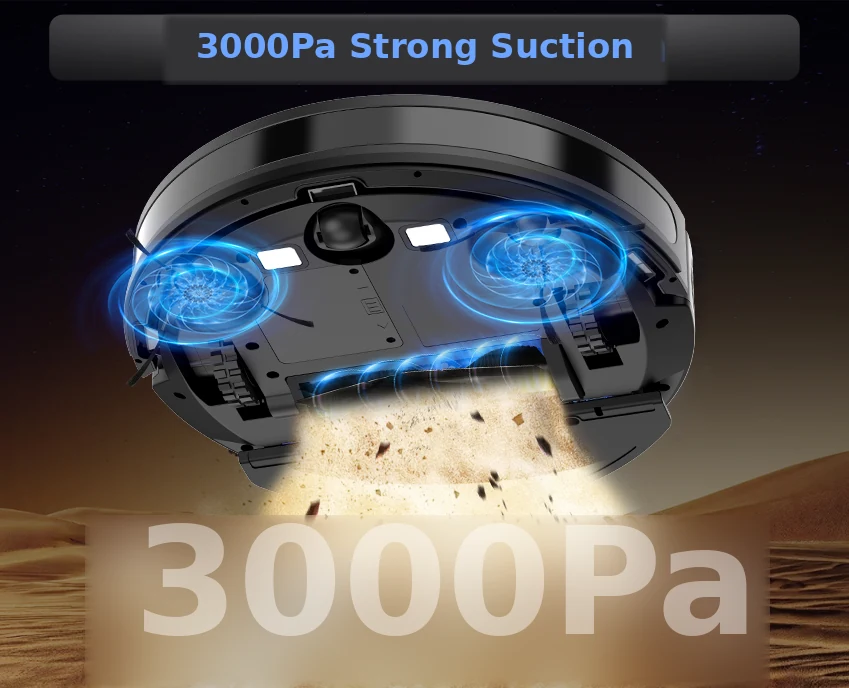
Not every customer needs laser mapping. The SG30 serves the biggest part of the market: buyers who want systematic cleaning, a real roller brush, and app control — at a price that leaves room for everyone's margin. Gyroscope navigation, 3000Pa suction, 120-minute runtime, and a 76 mm slim body that fits under low furniture.
Why Gyroscope Still Wins at This Price
Laser navigation is excellent — and it costs money. Every dollar spent on a LiDAR turret is a dollar not spent on the brush, the battery, or your margin. For the mid-range band, that trade-off rarely pays: most homes the SG30 cleans are flats and houses where a systematic zig-zag pattern covers every room without needing a floor map.
Gyroscope navigation gives your customers the thing that actually drives reviews — methodical coverage instead of random bouncing — while the savings go into a real roller brush, 120 minutes of runtime, and a price your channel can mark up twice. The budget robot vacuum band outsells LiDAR in volume year after year, and the SG30 is built to win it.
As a robot vacuum manufacturer, we build both. We recommend the SG30 when your buyers care about clean floors per dollar — and our SL40 LiDAR model when they ask for room mapping by name.
Gyroscope Navigation in Real Homes: What It Does — and Where It Stops
Your end customers will ask two questions: will it miss spots, and will it bump around? Give them straight answers and you will get fewer returns.
On missed spots: gyroscope navigation cleans row by row, so it misses far fewer spots than random-bounce robots. But a gyroscope builds no floor map. In a simple apartment with a clear layout, that barely matters. In a large home, a multi-room layout, or rooms packed with furniture, the SG30 can still miss the odd corner — and there is no room-specific cleaning or virtual wall to fix it afterward. For those homes, the honest recommendation is a LiDAR model such as the SL40.
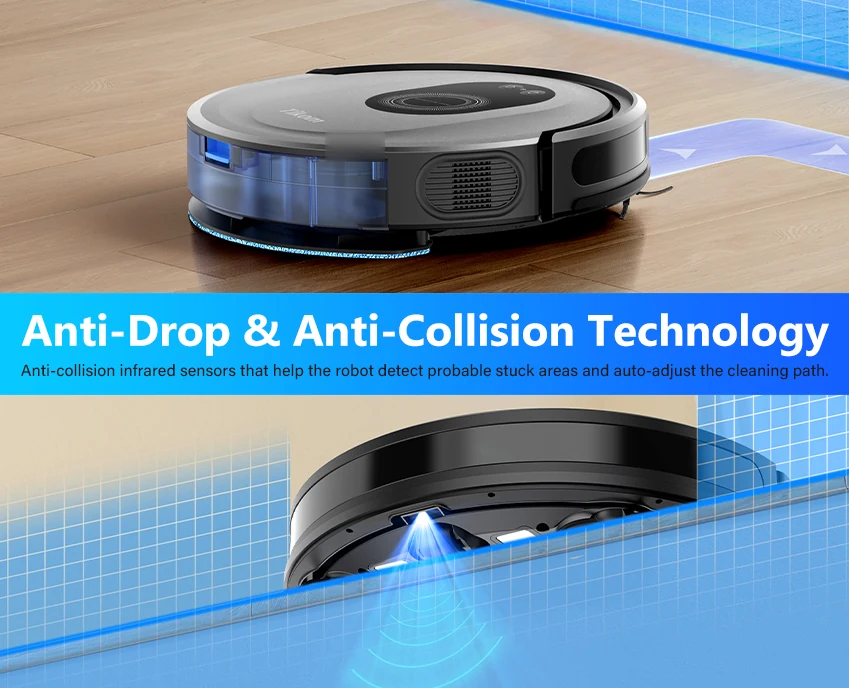
On bumping: the SG30 drives straight lines, not random wandering, and its bumper and anti-drop sensors handle everyday obstacles. It will still touch furniture legs — every robot without a map does — but it does so gently and systematically, not by bouncing from wall to wall.
On thresholds and dark floors: the SG30 crosses normal door thresholds between rooms and keeps cleaning on the other side. Its anti-drop sensors watch for stairs and ledges. Very dark floors can confuse cliff sensors on some robots in this class, so if a customer reports the robot stopping on a black rug, that is the first thing to check — it is a sensor behavior, not a breakdown.
One dimension note: at 320 mm across, the SG30 is slightly larger than the entry-level SG20 (285 mm), but the 76 mm height is unchanged — it still fits under sofas and beds. How to demo it in a showroom: run Auto mode on a marked rectangle of hard floor and let buyers watch the rows form. A two-minute live demo explains gyroscope navigation better than any spec sheet, and it sets the expectation that the robot cleans in lines, not by wandering.
What the SG30 will not do: it will not map your home, remember room layouts, or clean one room on command. It will not empty itself, wash its own mop, or avoid every chair leg. Those are station-model and laser-model features at higher prices. The SG30's job is narrower: clean the whole floor, methodically, every day, without fuss. When a buyer asks for mapping by name, that is not an objection to overcome — it is a signal to quote the SL40.
Setting expectations in listings: the strongest mid-range listings name the ideal home (“apartments and small homes with hard floors and low carpet”) instead of promising every home. State the runtime (120 minutes), the control options (app plus remote), and the maintenance in one line each. Buyers who know exactly what they are getting leave better reviews than buyers who were sold a flagship and received a workhorse.
Six Reasons Channels Reorder the SG30
The practical advantages your sales team will actually use.
Systematic zig-zag coverage
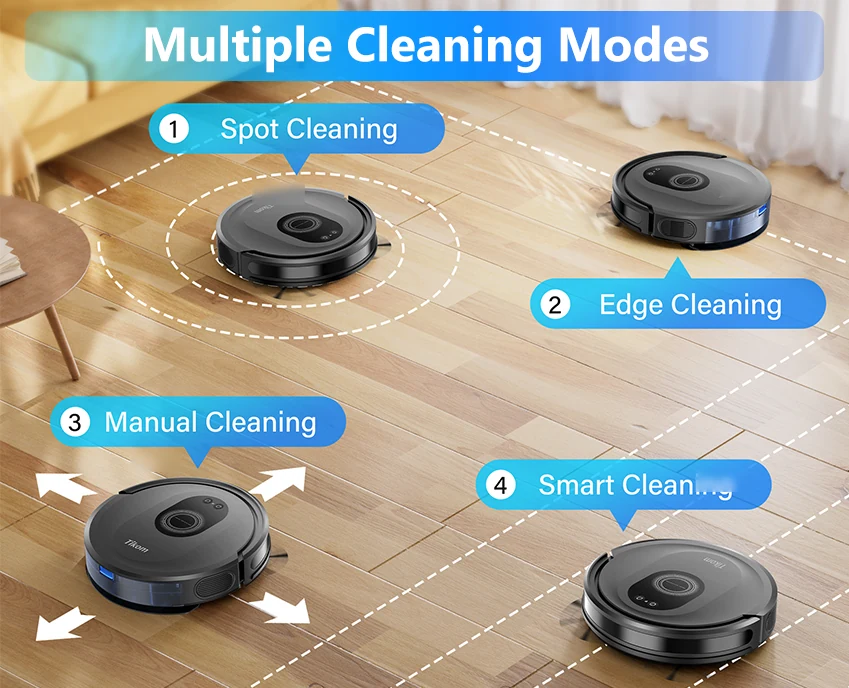
Gyroscope navigation cleans in orderly rows — Auto, Spot, Edge and scheduled modes — instead of bouncing randomly. Fewer missed spots, fewer "it doesn't clean well" returns.
Roller brush for real carpet
The main roller agitates carpet pile instead of gliding over it. Paired with 3000Pa suction and dual side brushes, one SKU covers tile, wood and carpet.
76 mm slim profile
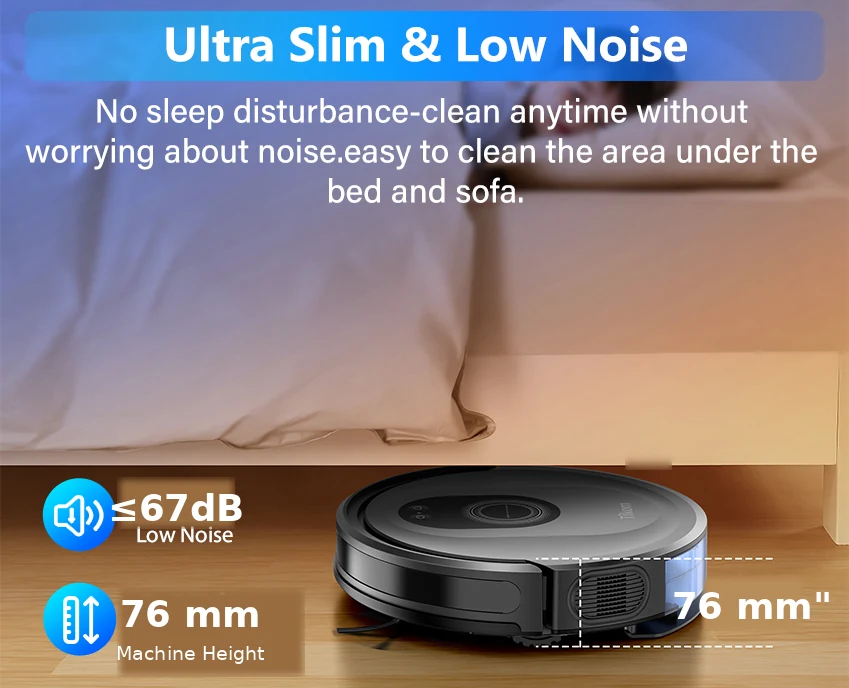
Slides under sofas and beds where taller LiDAR models get stuck. For retail buyers, that single dimension wins shelf comparisons.
2-in-1 vacuum + mop
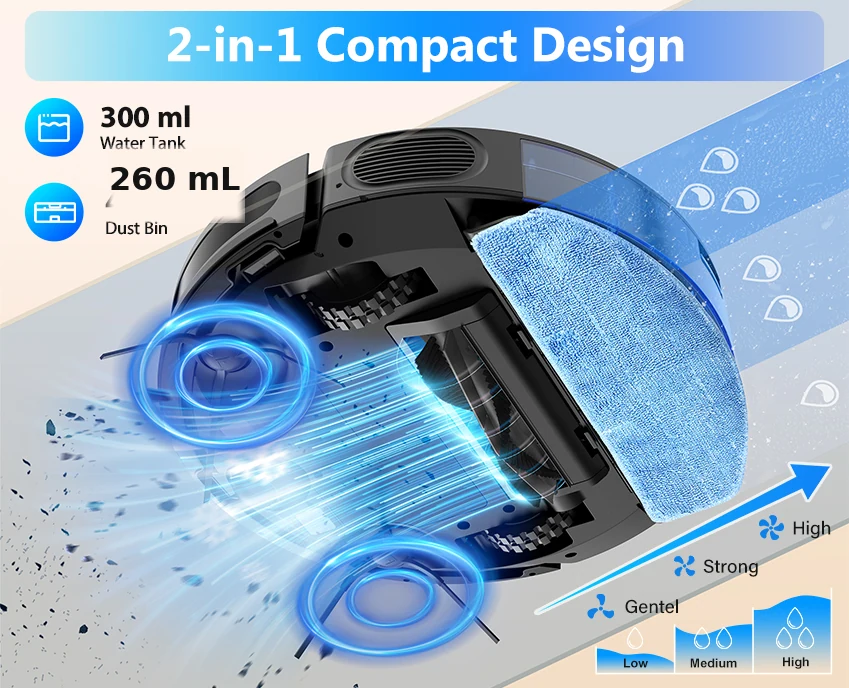
260 ml dust bin and 300 ml water tank in one unit. Your buyers get vacuuming and mopping without stocking extra accessories.
App + remote + auto-recharge
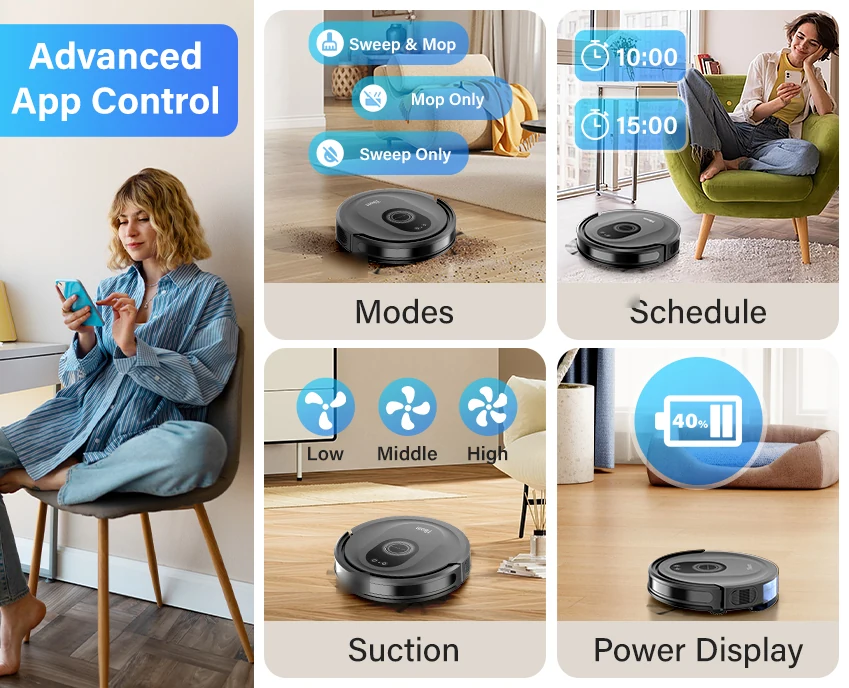
Tuya App scheduling and suction control, a physical remote for non-app users, and automatic return to the charging dock. 120 minutes per charge, ~4 hours to refill.
HEPA H11, ≤67dB
Fine-dust filtration for allergy-sensitive households, at a noise level that won't interrupt a work call. A genuine selling point for apartment listings.
Roller Brush or Suction Inlet? Help Your Buyers Decide
The most common question we get on gyroscope models — answered once, so your team can answer it a hundred times.
Choose the SG30's roller brush when your customers have carpet or rugs. The roller agitates fibers and pulls embedded dust and pet hair out of pile — a suction inlet alone can't do that. It needs the occasional hair check, which the manual covers in one page.
Choose suction-inlet (our SG20) when your customers have mostly hard floors and heavy-shedding pets. No brush means nothing to tangle — less maintenance, fewer support questions about wrapped hair.
Same gyroscope navigation, same app, same factory. Different cleaning head for different homes. Most distributors stock both and let the listing do the filtering.
Roller-Brush Maintenance, Spares & the Support Questions You'll Actually Get
The SG30 has a roller brush — the biggest maintenance difference from the SG20. Put these three points in your buyer manual and most support tickets answer themselves.
Daily care, in three lines for your manual: empty the dustbin after each use; drain and air-dry the water tank; check the roller for tangled hair and clear it with the included cleaning tool; tap the filter clean instead of washing it.
What to stock as spares: roller brush, side brushes, and filters. The roller is a consumable — channels should stock it. Support tickets naturally run a bit higher than for suction-inlet models, and your listing Q&A can say so directly.
“It stopped on my black rug”
Check the cliff sensors first, then move the robot to a lighter floor to confirm normal operation. Sensor behavior, not a breakdown.
“It is not picking up like before”
Empty the dustbin, tap the filter clean, and check the inlet and roller for a blockage.
“It will not dock”
Clear the space around the charging dock and wipe the charging contacts.
Maintenance schedule for your manual: after every use — empty the dustbin, drain and air-dry the water tank. Weekly — check the roller brush and side brushes for tangled hair, clear with the included tool, and tap the filter clean. Monthly — wipe the charging contacts and the cliff sensors, and check the side brushes for wear. Quarterly — assess whether the roller brush and filter need replacing, and reorder spares before they run out. A printed schedule in the manual turns maintenance from a support ticket into a habit.
Roller brush vs suction inlet, maintenance side: the suction-inlet SG20 has no roller to check, so its maintenance is shorter. The SG30 trades a few minutes of roller care for deeper carpet cleaning. When a buyer asks which is “easier to own,” that is the honest answer: the SG20 is easier to maintain; the SG30 cleans carpet better. Let the floor decide.
SG20 vs SG30 vs SL40 — Where the SG30 Sits
Three steps up the range. The SG30 is the middle one: the roller-brush gyroscope model.
| SG20 | SG30 | SL40 | |
|---|---|---|---|
| Navigation | Gyroscope | Gyroscope | LiDAR + SLAM |
| Cleaning head | Suction inlet | Roller brush | Roller brush |
| Max suction | 2500Pa | 3000Pa | 5000Pa (MAX) |
| Room mapping | — | — | Yes, with virtual walls |
| Band | Entry | Mid-range value | Mid-premium laser |
Need the flagship story instead? Step up to the SW75 all-in-one with dToF LiDAR and auto-empty station. See the full product lineup for every model.
SG30 Technical Specifications
Every figure below is verified against factory quotation sheets — no estimates.
| Navigation | Gyroscope; Zig-zag / Auto / Spot / Edge / scheduled cleaning |
|---|---|
| Brush system | Roller brush (efficient cleaning); 2 side brushes |
| Suction | 3000Pa |
| Power | 42W |
| Noise | ≤67dB |
| Filter | HEPA H11 |
| Battery | Li-ion 2600mAh / 14.4V |
| Runtime | 120 min |
| Charging time | Approx. 4 hours |
| Dust bin + water tank | 2-in-1: 260 ml dust bin + 300 ml water tank |
| Suitable floors | Tile / wood floor / carpet |
| Dimensions | 320 × 320 × 76 mm |
| Control | Tuya App + remote control + auto-recharge dock |
| Gift box | 43 × 35 × 11 cm |
| Carton | 4 pcs / carton; carton 45.5 × 36 × 45 cm; 15.5 / 18 kg |
| Loading quantity | 1300 / 2500 / 3100 pcs (20′ / 40′ / 40HQ) |
Where the SG30 Fits in Real Homes
The households your end customers will recognise — and the listing angles that sell to them.
Apartments
76 mm slim body and scheduled cleaning keep small flats clean while owners are at work. Quiet enough (≤67dB) to run during the day without complaints from neighbors.
Pet-owning families
Roller brush plus HEPA H11 handles hair and dander on hard floors and low carpet. For heavy-shedding homes that hate brush maintenance, point them at the suction-inlet SG20.
First-time robot buyers
App plus physical remote means nobody gets stuck on pairing day. Auto-recharge and scheduled cleaning make it genuinely hands-free — the experience that turns a first buyer into a repeat customer.
Four Channels, Four Ways to Sell a Mid-Range Model
The SG30 is a mid-range main SKU, not a traffic builder. Four channels, four ways to sell it.
Importers testing a market
A 500-unit order is under 40% of a 20ft container — enough to learn whether a market wants mid-range robot vacuums. Test with the SG30, then decide whether to add a laser model.
Distributors building a profit SKU
The SG30 is the core profitability SKU in the lineup. The SG20 drives traffic, the SG30 earns, the SL40 builds image. Three bands covered is a complete lineup.
E-commerce sellers
The selling point is rating defense — systematic coverage, the 76 mm slim body, and roller-brush carpet cleaning keep “missed spots” and “won't fit under the sofa” out of the reviews. Headline the roller brush and gyroscope row-by-row cleaning; do not invite comparison with laser mapping.
Retail & promotion
Higher perceived value than entry models, gift box ready — supermarket shelves, holiday promotions, corporate gifts. For gift and promotion orders, lock the color box and manual language early.
What not to promise per channel: importers — do not promise a fixed retail price before landed costs are known. Distributors — do not promise exclusivity in the first order; exclusivity follows proven volume. E-commerce — do not promise laser-style mapping in the title or bullet points. Retail — do not promise a delivery date before artwork is locked. Each broken promise in one channel costs the next order in every channel.
Which channel should you start with? If you already sell home appliances, start with your existing channel and add the SG30 as the mid-range tier. If you are new to robot vacuums, start with e-commerce: one listing, one configuration, and the reviews will tell you whether to add the SG20 below it or the SL40 above it.
OEM That Protects Your Margin
The SG30 is a volume model — so our OEM program is built for volume economics: low customization cost, fast proofs, packaging that survives ecommerce handling.
- Face-shell color — your brand palette or channel-exclusive colors. On a mid-range shelf, color is the cheapest differentiator there is.
- App logo & onboarding — Tuya-based pairing with your branding, so the product speaks your brand from the first connection.
- Packaging — gift box and carton tuned for your channel: retail-ready color boxes or ecommerce-optimized protective packing that survives the last mile.
- Manual language — multi-language manuals that cut the setup questions your support team would otherwise answer.
For the full program, see OEM / ODM and OEM robot vacuum options.


Value Engineering, Not Cost Cutting
A mid-range model has to be cheap to make and hard to break — those are different skills. Kingbot runs 6 production lines plus 2 packing lines (60,000 units/month capacity) with a 25-person QC department. On the SG30, the engineering budget went where owners notice it: the roller brush system, the 2600mAh battery delivering 120-minute runtimes, and the Tuya control module.
Factory: 3/F, Zhuangshi Industrial Zone, Longgang District, Shenzhen, China. More on our factory.

Tested Like a Flagship, Priced Like a Workhorse
The SG30 gets the same line discipline as our LiDAR models — because a budget price never excuses a dead-on-arrival unit:
- Suction verification — every unit's 3000Pa output checked on the line, not just the first article.
- Navigation pattern check — gyroscope zig-zag confirmed on a test floor; wandering units don't ship.
- Battery & dock cycle — charge, run, auto-recharge return verified per unit.
- App pairing — Tuya connection confirmed before packing, so pairing day works out of the box.
From incoming materials to pre-shipment, our quality control process ends with 100% full inspection — every unit, not a sample.


Aging tests catch what spot checks miss. Units run extended cycles in our aging area before the production standard is signed off — motors, batteries and sensors prove themselves before your order does.
Core Components
Only verifiable specification items are listed — each one traceable to the factory specification sheet.
- Gyroscope navigation module — drives the systematic zig-zag coverage pattern; the reason the SG30 cleans methodically instead of bouncing randomly.
- Roller brush + 2 side brushes — the main roller agitates carpet pile while side brushes sweep edges and corners into the suction path.
- Li-ion battery 2600mAh / 14.4V — up to 120 minutes of cleaning per charge, then automatic return to the dock.
- HEPA H11 filter — captures fine dust and allergens, a selling point for pet-owning households.
- Tuya smart control module — scheduling, mode selection and suction-level control from the app, plus a physical remote in the box.

Tuya App + Remote: A Simple Path for End Users
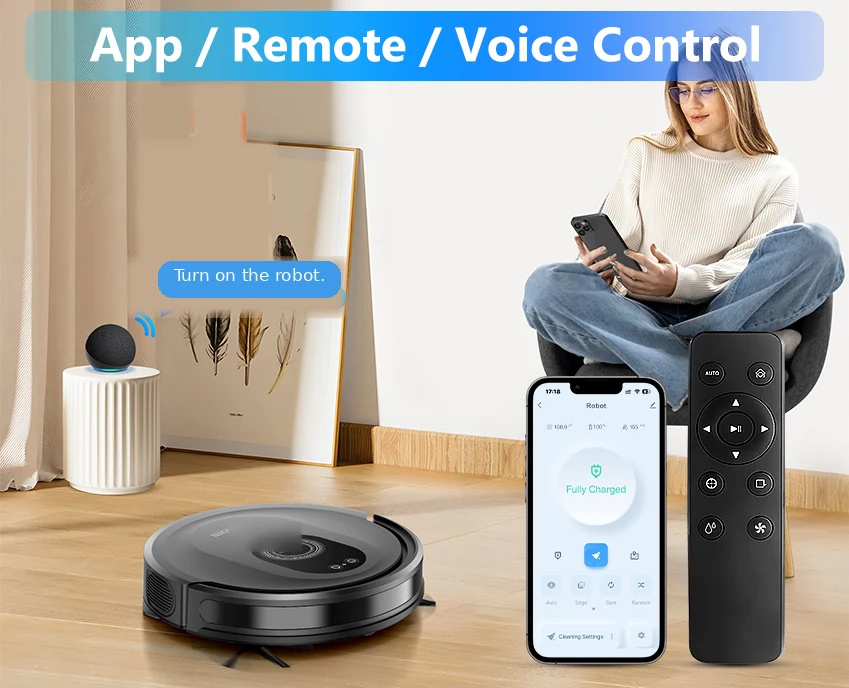
The SG30 supports three ways to control it: the Tuya App, the remote control, and the auto-charging dock. The positioning stays the same — simple first. Most users can press a button on the remote and start cleaning. The app is there for people who want scheduled cleaning, not a requirement for using the robot.
What the app adds: scheduled cleaning times, cleaning-mode switching, and suction-level control. Pairing follows the manual step by step. If pairing fails, the remote still runs the full cleaning cycle — nothing is blocked.
Advice for your customer service: write “remote works out of the box” and “app for scheduling” as two separate lines in the manual. Do not let end users believe the robot cannot clean until it is paired — that is the single most common support misunderstanding for mid-range models. For buyers who want deeper app-level customization, our OEM/ODM program covers app branding.
If pairing fails: first confirm the phone is on the same network the manual specifies, then restart the robot and retry from the app's add-device flow. If it still fails, the customer loses nothing — the remote runs Auto, Edge, Spot, and scheduled cleaning. Tell them that up front and a failed pairing stays a minor annoyance instead of a return.
App branding for private label: OEM orders can carry your brand in the app as well as on the shell and the box. Confirm the app branding scope when you confirm the artwork, so the app, the packaging, and the manual all ship with the same brand.
| Task | Remote control | Tuya App |
|---|---|---|
| Start cleaning | Yes — press a button | Yes — tap in app |
| Switch mode (Auto / Spot / Edge) | Yes | Yes |
| Schedule cleaning | Yes | Yes — with more detail |
| Suction-level control | Basic | Full control |
| Setup needed | None — works out of the box | Pairing per manual |
Paperwork That Clears Customs
The documents your freight forwarder and your retail buyers ask for before anything else:
- CE — EU safety and EMC conformity; the baseline your European listings depend on.
- RoHS — hazardous-substance compliance, increasingly screened by marketplaces before a SKU goes live.
- FCC — US radio compliance for the smart module; required for American ecommerce channels.
- MSDS — lithium-battery safety data. Your forwarder needs this before a battery-powered product ships — no MSDS, no sailing.
ETL / UL available on request — not standard. .


A 500-Unit Trial That Became a Repeat SKU
An Amazon seller in the home-cleaning category took a 500-unit trial order of a mid-range robot vacuum (40 days, FOB Shenzhen) to test one thing: whether a gyroscope model could hold a 4-star-plus rating without LiDAR. It could — systematic coverage and the slim 76 mm body did the talking in the reviews. The trial became a repeat SKU with larger follow-up orders.
Start with the band your customers actually buy, prove the rating, then scale.
From Sample to Shelf: The SG30 Order Flow
Five steps from first sample to a listing that sells — and the paperwork habits that keep each step on schedule.
Artwork files: send logo, color-box, carton-mark, and manual files in the formats the factory confirms at order time, and keep one approved master set. Every reorder, promotion rerun, and gift-box variant should start from that master set, not from a screenshot of the last shipment.
Pre-shipment evidence: review the pre-shipment inspection photos against the approved sample before the goods leave — appearance, accessories, packaging, and carton marks. Catching a wrong plug type or manual language at this stage costs days; catching it at port costs a season.
Timelines: confirm the production and shipping timeline at order confirmation, and confirm it again when artwork is locked. Artwork changes after lock are the usual reason a timeline moves, so treat the lock date as the real start of the clock.
First-order written confirmation: confirm every order in writing — model, quantity, plug type, manual language, artwork version, carton marks, and inspection standard. Verbal agreements drift; the written confirmation is what production builds to, and it is what inspection checks against. One delayed week at sample stage is cheaper than one container of mismatched goods.
SG30 vs Other Mid-Range Options: A Buyer's Comparison
Three comparisons your buyers will make — answered before they ask.
SG30 vs random-bounce entry (V27)
The V27 is the lower-priced random-bounce entry model — 1000Pa suction, 90-minute runtime, 400 ml dustbin + 150 ml water tank, 290 × 290 × 78 mm. Against it, the SG30 trades a slightly smaller dustbin for gyroscope row-by-row navigation, 3000Pa suction, a 120-minute runtime, and a roller brush. If the channel's buyers compare on price alone, the V27 wins the shelf tag. If they compare on cleaning behavior — straight lines, fewer missed spots, stronger suction — the SG30 wins the review.
SG30 vs other mid-range gyro models
Compare four things: roller brush or suction inlet (carpet-first homes want the roller); dustbin and water tank sizes (is 260 ml + 300 ml enough?); an app that really works (Tuya plus a physical remote, two channels); and complete certifications and carton marks (CE / RoHS / FCC / MSDS — no MSDS, no sailing). Then compare cartons per container — mid-range profit hides in logistics.
SG30 vs SL40
Not competitors, but division of labor. Buyers who ask for room mapping and virtual walls by name get the SL40; buyers who only care about clean floors at a reasonable price get the SG30. The SG30 opens the account; the SL40 grows the order.
What to check on a competitor's mid-range listing: does it name a real suction figure or hide behind “powerful suction”? Does it show the dustbin and water tank sizes, or leave them out? Does it claim mapping without a laser? Does it list certifications with a document pack, or just print CE on the box? The listings that hide numbers are the ones whose reviews complain about them. The SG30 page lists every number — that is the comparison to win.
The Math of a 500-Unit Order
The same standardized terms as every Kingbot model — here is what they mean for the SG30 specifically.
- MOQ: 500 pcs per model — including your first trial order; one threshold across the lineup.
- Trade term: FOB Shenzhen — 1300 / 2500 / 3100 pcs per 20′ / 40′ / 40HQ. Four units per carton keeps your per-unit freight low.
- Payment: 30% deposit + 70% before B/L — production starts on deposit receipt.
- Lead time: confirmed with your order — quantity and customization scope decide it; quoted in writing before you commit.
- Samples: available — tell us your market and volume; we arrange the configuration you need to evaluate.
How wholesale works across the lineup: wholesale robot vacuum cleaners.
Building the landed-cost math: per-unit freight is only one piece. Add import duty for your market, port and warehouse handling, and last-mile delivery before you set the retail price. Confirm the duty rate for robot vacuums in your destination country before quoting retail partners — duty varies by market, and it moves the margin more than the freight does at this price tier. A 500-unit order fills under 40% of a 20ft container, so consolidated sea freight keeps per-unit freight low; the carton math (4 units per carton, 1300 units per 20ft) is what makes the mid-range band work.

Assembly Line Walkthrough
Watch how Kingbot robot vacuums come together — from component assembly to final inspection.
SG30 Evaluation FAQs
What is the MOQ for the SG30?
SG30 or SG20 — roller brush or suction inlet?
How does gyroscope navigation compare to LiDAR?
Which app does the SG30 use?
What certifications does the SG30 hold?
Can I private-label the SG30 with my own brand?
How is the SG30 shipped?
How do I get a sample?
Will the SG30 miss spots? How is gyroscope navigation different from random bounce?
How do I maintain the SG30's roller brush?
What if pairing fails? Can the remote fully replace the app?
Can the SG30's mopping replace a mop?
What spares does the SG30 need?
What should I test when the sample arrives?
Is the SG30 suitable for promotion, gift, or supermarket channels?

Ask About SG30 MOQ, Samples & OEM
Tell us your market, target quantity and customization needs. We reply with a quotation, lead time and sample arrangement.
Prefer email? helen@king-bots.com