

Kingbot Cleaning Appliance Factory
As a cleaning appliance factory, Kingbot runs dedicated assembly lines for robot vacuum cleaners, wet dry floor washers, window cleaning robots and robotic pool cleaners, supported by quality control laboratories and mass production infrastructure. Examine our verifiable evidence to conduct thorough due diligence before your RFQ.
What Buyers Can Verify at Kingbot
Kingbot opens its process to procurement teams conducting supplier due diligence. Instead of vague marketing claims, we lay out the operational facts so you can accurately assess our capabilities before entering an OEM agreement. How our OEM program works
Our Transparent Approach: Factory vs. Trading
We believe in complete supply chain transparency. We clearly distinguish between what we engineer and assemble in-house (firmware, PCBs, motors, final integration, and testing) versus what we outsource to our audited local partners (e.g., heavy plastic injection molding). This ensures you get direct-factory pricing without the hidden risks of unverified trading companies.
-
Production Ownership: Clear distinction between our in-house final assembly/QC and our audited supply chain partners.
-
Lines & Equipment: Photographic evidence of active assembly lines and dedicated reliability lab testing stations.
-
Quality Records: Specific checkpoints audited during IQC, IPQC, and OQC phases under precise engineering tolerances.
-
Capacity & Delivery: Realistic production volume calculations managed by our procurement and supply chain experts.

What "Factory" Means at Kingbot: In-House Work vs. Audited Partners

At Kingbot, "factory" means the following. Firmware, PCBs, motors, final assembly, and testing are done in our own facility in Shenzhen. Heavy plastic injection molding and similar processes are outsourced to long-term audited local partners. This split is not reselling, and it is not a trading company wearing a factory label. Injection molding is a capital-intensive general process; the processes that decide quality and consistency — firmware, PCB integration, motor assembly, final integration, and testing — stay in our own hands.
Kingbot sets the BOM, the firmware, and the testing standards. Partners execute to Kingbot's SOPs and inspection standards. That is the whole arrangement: one set of standards, one inspection system, whether the work happens on our own floor or on a partner's floor.
To verify this split, look at three things. First, the inspection records at each gate — IQC, IPQC, OQC. Records show whether the system actually runs, not just whether it is described. Second, the Golden Sample. Mass production must match the approved Golden Sample, and the Golden Sample is the reference every gate measures against. Third, a video walkthrough or an on-site visit, to see whether the lines and the lab are really running. The word "factory" alone verifies nothing. Evidence does.
Factory Facts at a Glance
| Legal Entity | Shenzhen KingBot Robot Co., Ltd |
| Factory Address | 306 Zhuangshi Industrial Zone, Longgang District, Shenzhen, China |
| Facility Scope | Scalable layout (Detailed floor plan for production, testing, and warehousing available upon audit) |
| Production Lines | 6 production lines |
| Lab Equipment Scope | High-Low Temp Chambers, Aging Test Racks, Salt Spray Testers, Button Durability Testers |
| Main In-House Processes | Final Assembly, Firmware Flashing, 100% Functional Testing, Reliability Testing, Packaging |
| Quality System | Follows standard QMS guidelines (Records auditable during factory review) |
Factory Engineering Support
A successful mass production run starts long before the assembly line. Our factory engineering team ensures Design for Manufacturing (DFM) by conducting rigorous circuit simulations, firmware debugging, and rapid prototyping to eliminate risks during the pilot run phase.

DFM Engineering Sync
Cross-functional review of circuit schematics and BOM optimization to meet OEM buyer requirements before mass assembly.

PCB & Layout Design
Custom motherboard layout and component positioning ensuring optimal thermal management during continuous operation.

Production Firmware
Writing and flashing proprietary logic algorithms for navigation, self-cleaning, and sensor polling for the assembly line.

Pilot Prototype Soldering
Hand-assembling early-stage PCBs to verify circuit integrity before authorizing SMT mass production to our partners.

Oscilloscope Debugging
Measuring signal noise, voltage drops, and sensor latency to ensure long-term electronic stability for bulk orders.

Rapid Tooling Verification
Printing custom chassis elements and structural mods overnight to accelerate the ODM approval and mold modification phase.
Manufacturing Adaptability
We adapt our lines to address the unique engineering challenges of each product type, ensuring precision assembly across four core categories.
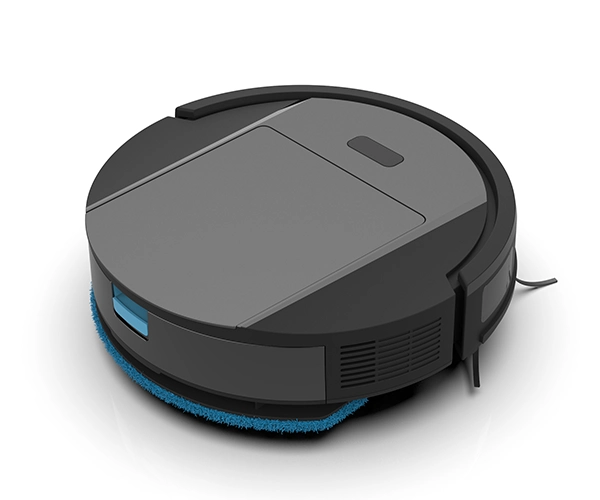
Robotic Floor Cleaners
Manufacturing focuses on precision assembly of drive wheels, suction motors, and delicate sensor arrays. Critical checks include strict LiDAR calibration tolerances.
View Category
Wet Dry Floor Washers
Assembly lines are equipped with specialized stations for water pump installation, clean/dirty tank sealing verification, and electrical safety isolation checks.
View Category
Window Cleaning Robots
Safety dictates the process. Key focus areas include high-RPM vacuum motor mounting, safety tether anchor strength testing, and backup battery charge verification.
View Category
Robotic Pool Cleaners
Built for submersion, these units undergo rigorous IPX8 level waterproofing protocols. Assembly processes emphasize gasket seating and drive-track tension calibration.
View CategoryFour Product Lines, Four Different Factory Problems

The four product lines are not the same line with a different shell. Each line has a different factory problem, and each problem decides where the line's quality risk sits.
Robot vacuums: precision assembly of drive wheels, suction motors, and delicate sensor arrays. The critical step is LiDAR calibration tolerance. If calibration is off, navigation is off — and no downstream test can fully compensate for a sensor that was mounted or calibrated wrong at assembly.
Wet dry floor washers: water pump installation, clean / dirty tank sealing verification, and electrical safety isolation checks. Water circuits and electrical circuits live in one machine. Sealing and isolation are the focus, because a leak is not a cosmetic defect — it is water where electricity lives.
Window cleaning robots: safety first. High-RPM vacuum motor mounting, safety tether anchor strength testing, and backup battery charge verification. The machine hangs on the outside of the glass, high above the ground. No step in this line can rely on luck, and the tether and the backup battery are the two things standing between a normal clean and a falling machine.
Robotic pool cleaners: IPX8-level waterproofing. Gasket seating, drive-track tension calibration. The whole unit works submerged, so waterproofing is not one test item among many — it is the survival line. A gasket seated a fraction off is a unit that takes in water.
What this means for buyers: verify each line against its own focus. Check calibration on robot vacuums, sealing on floor washers, safety on window robots, waterproofing on pool cleaners. One checklist does not fit all four lines, and a factory that is strong on one line has not automatically proven the other three.
Reliability Testing Laboratory
Beyond standard assembly line checks, our in-house QC lab subjects sample batches to extreme environmental and mechanical stress to ensure long-term lifespan.
View Standard AQL & QC Checkpoints
High-Low Temp Chamber
Subjects complete units and battery packs to extreme thermal cycling (-20°C to 60°C) to ensure plastic integrity and battery safety.

Constant Aging Chamber
Simulates thousands of hours of continuous motor operation to identify early-life failures before mass production release.

Salt Spray Tester
Accelerated corrosion testing for exposed screws, charging contacts, and pool robot motor shafts (IPX8 components).

Key Durability Tester
Automated pneumatic pressing to verify tactile switches and membrane buttons survive high-frequency actuation cycles.
QC Beyond the Lab: What Each Gate Checks, from IQC to OQC

The lab is only part of QC. A batch does not pass because it passed one test; it passes because it passed four gates in sequence, and each gate has its own job.
IQC — incoming inspection. Incoming materials are sampled to AQL. Key components — batteries, motors, PCBs — get the closest checks. Non-conforming materials do not enter the line. Stopping bad material at the door is cheaper and safer than finding it in a finished unit, and it is the first place a weak factory shows.
IPQC — in-process inspection. Line patrols monitor continuously to SOPs and inspection standards. Drift is corrected as soon as it is found, not after the batch is finished. A line that only checks finished units will always be one batch late.
FQC — final inspection. 100% functional testing of core features, plus batch aging and stress testing. Every unit's core functions are tested, not sampled — sampling is for the batch-level stress tests, not for whether the unit works.
OQC — outgoing inspection. Final inspection before shipment plus packaging verification. Critical defects — battery failure, water leaks — have zero tolerance. No rework, no negotiation, no shipment.
AQL standard: 1.5 for Major defects, 4.0 for Minor defects. Every gate keeps records — IQC pass records, IPQC routing logs, FQC yield reports, OQC reports — and buyers can ask to see them. Records are the difference between a QC system that runs and a QC system that is only described.
Buyer Factory Audit Checklist
We have standardized our verification process to save time for your procurement team. You can follow these three steps to assess our manufacturing capabilities accurately and securely. By supplying your product line, target market, and projected order volume up front, we can prepare the precise evidence required for your specific regional compliance.
Explore All Buyer Guides & Resources
Preliminary Document Review
After a brief qualification call to understand your target market, we provide access to our verifiable documents. This includes our business license, QMS records, and sample CE/FCC/RoHS test reports matching the specific cleaning appliances you intend to source.
Live Video Walkthrough
We schedule a live video call where our team walks you through the factory floor. You can request real-time, unfiltered views of our incoming material quarantine area (IQC), active assembly lines, and functional testing stations to verify daily operations.
On-Site / 3rd-Party Inspection
Before your bulk order is loaded, we fully support your appointed third-party inspection agency (such as SGS). They are granted full access to conduct standard AQL checks, drop tests, and packaging verification on finished goods within our warehouse zones.
Verification in Three Steps: What to Read First, What to Request Next

Verify in this order.
First, read the evidence: line photos, the lab, the 7-step process, the documents section. Decide whether this factory's processes and inspection system match the type you need. A factory that shows its process is more useful than one that only claims capacity, because the process is what you will actually be buying into.
Second, request the document pack: business license, QMS documentation, test reports for the model you are sourcing (CE / FCC / RoHS / UN38.3), blank IQC / OQC record templates. The pack needs a short qualification first — target market, product line, projected volume — because documents are matched to your target market and model. Different markets need different compliance documents, and the wrong pack is no pack at all. Blank record templates matter: they show you what the factory measures, not just what it claims.
Third, book a video walkthrough or an on-site / third-party inspection. Sensitive operational documents are shared securely only after qualification, never posted publicly. That is not secrecy for its own sake — it is how the documents stay matched to real buyers instead of circulating as unverifiable screenshots.
What to Ask on a Video Walkthrough
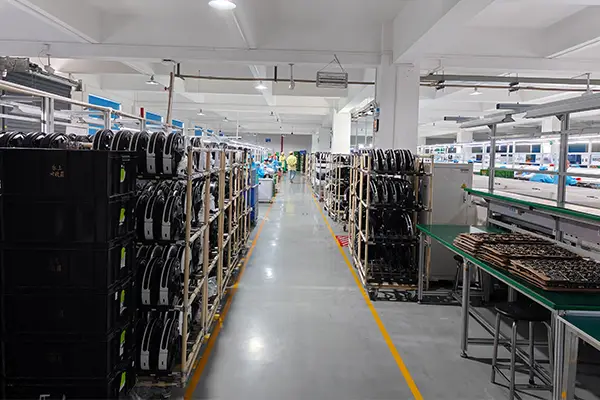
A video walkthrough is only useful if you ask for the right things. A supplier can show you a clean corner for two minutes; that proves nothing. Ask for these, in this order:
1. Show the incoming material quarantine area (IQC). Bad material stopped at the door is the first sign the system actually runs.
2. Show the assembly line running, not empty. Ask to see the current batch and the line's station cards — the cards show what each station checks, and empty lines have no cards worth reading.
3. Show the QC stations mid-test: 100% functional testing, aging racks, drop test. Ask what the pass / fail criteria are, and what happens to a unit that fails — rework, retest, or scrap?
4. Show the Golden Sample area. Ask how mass production is compared against the Golden Sample, and who signs off the comparison.
5. Show the packing and finished-goods area. Ask how finished cartons are marked and traced back to their batch — if a problem shows up after shipment, can the factory trace it to one batch and one line?
6. Ask for one record on screen: an IQC pass record, an IPQC routing log, or an FQC yield report for a recent batch. A factory that runs a real system can pull one up. A factory that only describes one cannot.
Book a walkthrough through the inquiry entry below. The export team schedules it after the short qualification — product line, target market, projected volume — so the right line and the right documents are ready when you join.
Factory Red Flags — and the Evidence to Ask For

When you evaluate any cleaning appliance factory, watch for these red flags. Each one has a simple counter-evidence test.
Red flag 1: no Golden Sample process. If the supplier cannot describe how mass production is matched to an approved Golden Sample, there is no reference standard for the batch. Counter-evidence: a Golden Sample step with a sign-off, and records showing mass production compared against it.
Red flag 2: no records at any gate. Claims of "strict QC" with no IQC / IPQC / FQC / OQC records to show. Counter-evidence: blank record templates plus a recent batch's filled records — templates show what is measured, filled records show the system runs.
Red flag 3: no AQL sampling. If the supplier has never heard of AQL, or cannot state its Major / Minor limits, the batch is not sampled to any standard. Counter-evidence: a stated AQL — ours is 1.5 for Major defects, 4.0 for Minor — and an OQC report that uses it.
Red flag 4: no third-party inspection access. A supplier that refuses buyer-appointed inspectors, or only allows its own staff to inspect, is hiding the batch. Counter-evidence: explicit support for third-party agencies, with access to the floor and the warehouse.
Red flag 5: no clear split between in-house and outsourced work. A supplier that claims "we make everything" but cannot say which processes are in-house and which are outsourced is usually reselling. Counter-evidence: a stated split — at Kingbot, firmware / PCBs / motors / final assembly / testing in-house, heavy plastic injection molding with audited partners — and inspection records that cover both sides.
Red flag 6: no traceability. If finished cartons cannot be traced back to a batch and a line, a defect found after shipment cannot be contained. Counter-evidence: batch-marked cartons and a trace path from finished goods back to the line that built them.
Use this list on us the same way you would use it on any other supplier. Ask for the evidence, not the claim.
OEM/ODM Factory Production Process
This is the process every Kingbot batch follows, from specification sign-off to container loading. Each step has a checkpoint; no batch advances until its checkpoint passes.

Specification Confirmation
Finalize production specifications (including certifications, labeling, and packaging artwork) to prevent mid-production changes.
Component Procurement
Sourcing verified core components including Li-ion batteries, BLDC motors, and main PCBs under strict IQC inspection protocols.
SMT & PCBA Assembly
Surface-mount technology placement of motherboard components followed by automated optical inspection to eliminate solder defects.
Final Assembly & Test
Full unit assembly combined with 100% functional testing of suction, navigation, charging, and sensor operation.
Reliability Verification
Batch-level aging tests, drop tests, and continuous run simulations to verify lifespan under real-world conditions.
Packaging & Export
Master carton packing and container loading with full export documentation management (CE / FCC / RoHS / UN38.3).
How Lead Time Is Built (and Why a Single Number Misleads)

There is no single lead time for a first order, and any supplier who quotes one without asking about your specification is guessing. Lead time is built from four parts, and each part depends on decisions only you can lock.
Part 1: spec lock. Until the specification sheet is signed — model, configuration, certifications, labeling, packaging artwork — nothing else can be scheduled. An unsigned spec is not a delay in production; it is a delay before production exists.
Part 2: material procurement. Lithium batteries and motors have the longest procurement cycles of any component in the BOM. Ordering them early, right after spec lock and deposit, is what keeps the rest of the schedule honest. A supplier who waits to order materials waits to discover the shortage.
Part 3: ODM mold work and pilot run, if your order needs them. Custom molds take time to cut, test, and adjust. The pilot run exists to catch what the mold got wrong before it becomes ten thousand units of the same mistake. ODM orders take longer than OEM orders for exactly this reason — and the pilot run is the step you never want a supplier to skip.
Part 4: peak-season effects. Q3 pre-holiday production and the Chinese New Year period compress capacity across the whole industry. We advise forecasting inventory 3–4 months in advance in peak periods, because the same line that builds your batch is building everyone else's.
Once the specification sheet is signed and the deposit is placed, we calculate a date from these four parts. Until then, any number is a guess — and a guess that later slips is worse than no number at all.
Key Documents Available for Review
Compliance is specific to your target market. The document pack is matched to your product line and market after a short qualification. We provide verified samples of the following documents for your legal and QA review:
Business License
Full legal entity verification including registered address and operating scope.
CE / FCC / RoHS Test Reports
Model-specific certificates and third-party test reports required for EU/US market entry.
UN38.3 Battery Test Report
Lithium battery transport safety certification required for air/sea freight compliance.
Factory QMS & Production Records
Blank templates of IQC / OQC records, plus completed inspection records for recent batches, available to verified buyers.


CE Verification

ISO 9001

RoHS

Radio Test Report
Factory & Product Overview
A combined factory and product overview — the facility, the lines, and the products they build — so you can see the operation in one video.
Video: Kingbot Factory & Cleaning Appliance Product Overview | Robot Vacuum, Floor Washer, Window Robot. For a live, line-by-line look, book a video walkthrough or an on-site visit.
Book a live factory reviewFrom RFQ to First Shipment

The path from your first inquiry to your first shipment follows the same sequence every time.
Step 1 — RFQ. Send product line, target market, projected volume, voltage / plug, labeling and packaging requirements, target compliance. The clearer the RFQ, the more realistic the quotation and date you get back.
Step 2 — Sample. Order a sample and test it against your market's requirements — suction, navigation, sealing, safety, packaging. The sample is your reference for everything that follows.
Step 3 — Golden Sample approval. The sample becomes the Golden Sample once you approve it. Mass production must match it. No Golden Sample, no production — this is the rule that keeps the batch honest.
Step 4 — Production. The 7-step process runs: spec confirmation, procurement, SMT & PCBA, final assembly & test, reliability verification, packaging & export. Each step has a checkpoint; no batch advances until its checkpoint passes.
Step 5 — Inspection. OQC plus your third-party inspection, if you appoint one. Critical defects — battery failure, water leaks — have zero tolerance. Only goods that pass OQC are released for shipment.
Step 6 — Shipment. Packaging verification, export documentation (CE / FCC / RoHS / UN38.3), container loading. Batch-marked cartons keep the shipment traceable back to the line that built it.
Ready to Verify Our Factory?
Whether you need factory documentation, a live walkthrough, or a third-party inspection setup, our export team coordinates the process.
Document packs and factory visits are provided after a short qualification — product line, target market, and projected volume — so the documents and lines shown match your sourcing needs.
Factory Verification FAQ
Is Kingbot a manufacturer or a trading company? How transparent is the supply chain?
What are your standard AQL limits for mass production?
Can buyers review factory and inspection documents?
How do I start the verification process or contact you?
What documents can I request before placing an order?
What is the difference between OEM and ODM — and what changes in practice?
How long does a first order take?
Can I use my own third-party inspection agency?
What happens to goods that fail inspection?
Can you make a product that is not in your current catalog?
What should I put in my first RFQ to get a realistic quotation and date?
Do you support private label / custom packaging?
Can I visit the factory in person?
What certifications do your products carry?
Who do I talk to, and how fast will I hear back?
Next Step: Request Your Verification Pack
Our export team responds to all B2B inquiries within 24 hours. Tell us your product line, target market, and projected volume, and we will prepare the right evidence pack — documents, video walkthrough, or on-site inspection. Explore our home page for the full product range, or contact us to start.